Aarhus in a Quantum Leap: “If you wait until the technology is ready, you’ll be left behind”
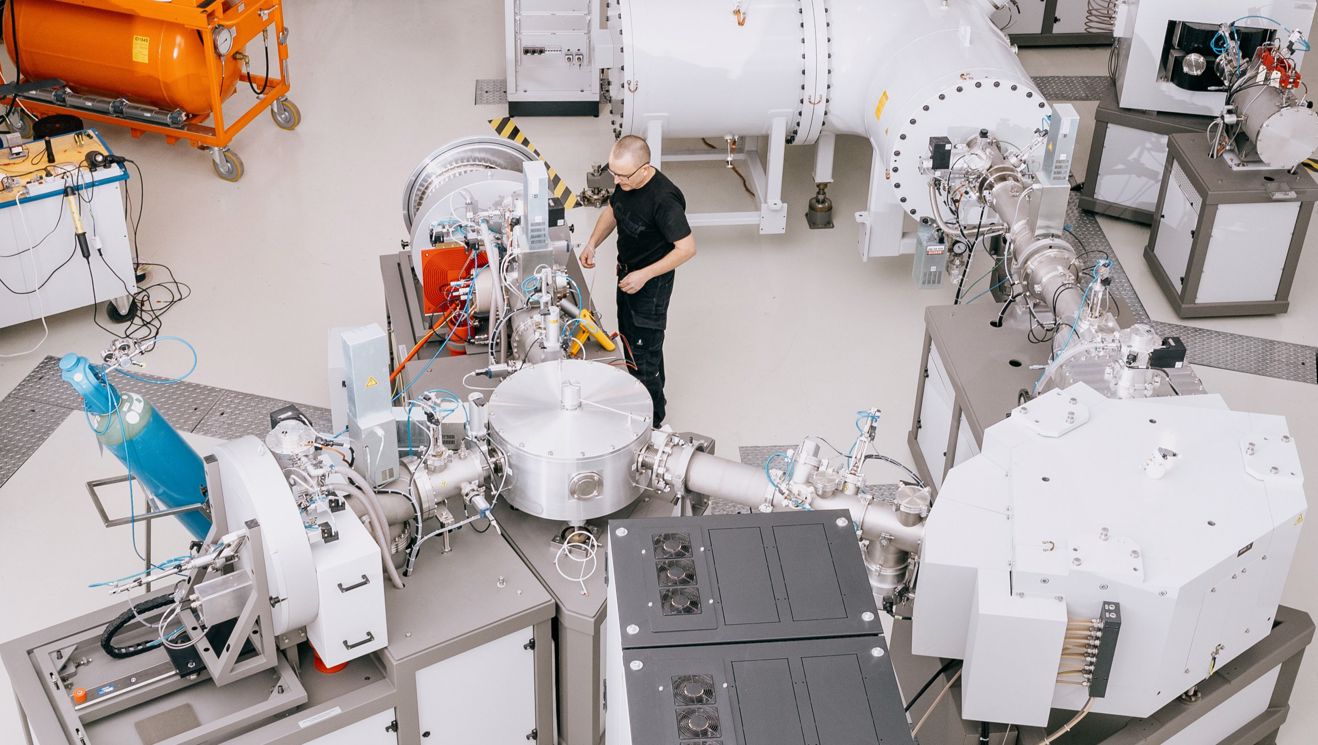
Photo: Jens Hartmann Schmidt, AU Photo - At ASTRID 2, Denmark’s largest particle accelerator at Aarhus University researchers study materials and physical structures at very small scales, producing knowledge that may support future advances in quantum science and technology.
In a small office behind the yellow walls of the University Park, we meet chemistry professor and director of Quantum Campus Aarhus, Ove Christiansen, and the coordinator of Quantum Campus Aarhus, Lise Refstrup Linnebjerg Pedersen. The left wall of the room is covered by a massive bookshelf filled with books on chemistry and quantum mechanics, reflecting decades of academic curiosity and research. Ove’s research area has been a well-known part of the natural sciences for over 100 years. Yet interest in quantum technology is higher than ever.
“Quantum research describes everything in the world and is fundamentally theoretical and philosophical,” says Ove. “But now we are starting to explore what we can concretely and technologically use it for. Several technologies are now beginning to support quantum applications. That’s why there is a new focus on the field.”
This is what some call “Quantum 2.0” or the second quantum revolution. It is no longer only about philosophical questions like Schrödinger’s cat. It is about tangible applications: quantum computers, sensors, and encryption that could have decisive impact on many areas of industry and society.
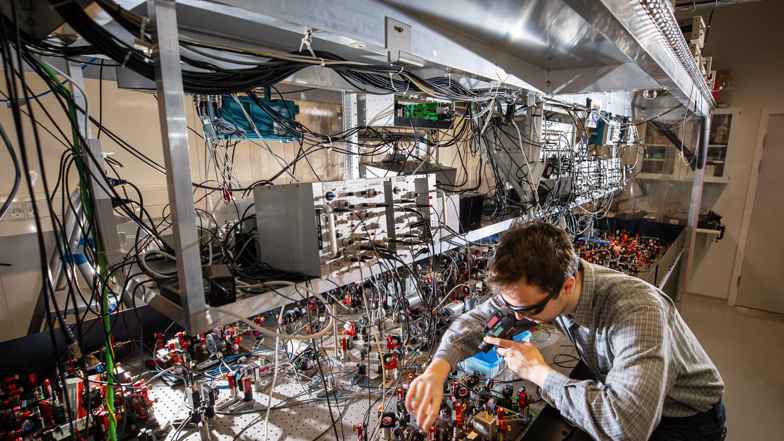
In LaserLab at Aarhus University, researchers use advanced laser experiments to explore how light interacts with matter — an important part of the broader research behind emerging quantum technologies. Photo: Lars Kruse, AU Photo
The quantum race and the risk of over-optimism
Quantum mechanics was originally developed by scientists such as Niels Bohr and Werner Heisenberg in the early 20th century. It describes the most fundamental processes of nature but has long been limited to theory and mathematical models.
What is changing now is the convergence of advances in new hardware, algorithms, and software, bringing us closer to a future where quantum computers can unlock insights and solutions previously beyond our reach. At the same time, a global race between nations and large companies has increased the pressure to be among the first to make quantum computers work in practice.
The growing interest has also raised concern among some researchers. Even though the potential is enormous, many of the visions often mentioned publicly are still far off.
“There is a nervousness that the hype is being pushed too high,” says Ove Christiansen. “If expectations become too high compared to what is actually achievable in the short term, we risk disappointment, where enthusiasm drops drastically because the technology doesn’t live up to the hype soon, even though it may deliver significant value in the long run” emphasizes the chemistry professor.
Quantum computers are often described as machines that can solve almost all types of problems much faster than traditional computers. But that is unlikely to be how it works.
“I believe quantum computers will excel at certain specific types of problems, but not at everything,” he says. One area where Ove does believe quantum computers could have major impact is chemistry.
Quantum computers could potentially revolutionize chemistry
Quantum technology originates in physics, but today the technology is also moving into the world of chemistry. Molecules and chemical bonds are governed by quantum mechanical rules, making them extremely complex to simulate on classical computers. Even the largest supercomputers struggle to model larger molecules accurately. Here, quantum computers could in principle provide researchers with a completely new toolkit.
In Aarhus, researchers are working on developing algorithms and software that can utilize future quantum computers to simulate molecules more efficiently. This work is also done in collaboration with the Aarhus-based company Kvantify, which develops software for creating new drugs that can run on both quantum and classical computers. The goal of the collaboration is to develop advanced theories and software that removes many of today’s barriers, allowing researchers and companies to focus on scientific problems rather than hardware limitations.
“If you wait until the technology is ready, you’ll be left behind. That’s why we are happy to work with companies that are quick to experiment,” says Ove Christiansen.
However, the technology is still in an early phase. Hardware development is primarily happening at large international companies and research centres, and it is still uncertain how quickly quantum computers can be scaled.
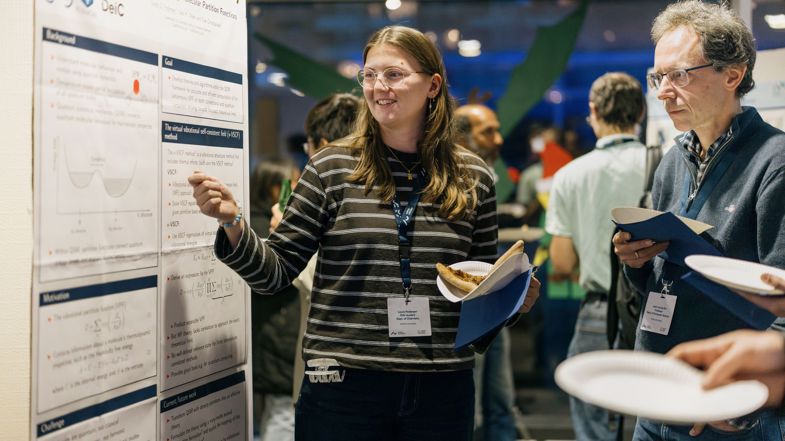
Sharing ideas across disciplines: a PhD student from the Department of Chemistry presents her research at the Quantum Campus Aarhus Annual Meeting in December 2025. Photo: Liv Lindhardt Rohde Larsen, AU Photo
Quantum Campus Aarhus
Collaboration on quantum technology is also being strengthened internally at Aarhus University. As technology begins to catch up with theory and new advances potentially enable technological breakthroughs, researchers at Aarhus University have pooled their efforts in Quantum Campus Aarhus (QCA).
QCA provides a shared framework for Aarhus University’s quantum activities, helping to connect environments that were already strong in their own right and making the overall quantum effort in Aarhus more visible and coherent.
QCA aims to gather researchers in an interdisciplinary network that includes participants from different faculties. The network spans natural sciences, technical sciences, and health sciences, bringing together researchers from physics, chemistry, computer science, mathematics, and iNANO, as well as from humanities and social sciences (ARTS and BSS). The goal is to combine deep theoretical knowledge with practical experiments, innovative software solutions, post-quantum security, and the development of new materials and drugs. At the same time, QCA explores how quantum technology affects society—from ethics and policy to business applications and social perspectives.
“Quantum Campus is a place where we can combine forces and inspire each other,” says Ove Christiansen.
Lise Refstrup Linnebjerg Pedersen, coordinator for QCA, elaborates: “We try to combine deep theoretical knowledge from the natural sciences with practical experiments and business perspectives. Inspiration can be crucial for new projects and joint research, and collaboration across disciplines creates opportunities that single-discipline research rarely can achieve.”
Quantum Campus Aarhus builds on the university’s strong tradition in quantum research, spanning fundamental quantum physics, development of new quantum materials and sensors, and theoretical and computational quantum chemistry. The network functions as a catalyst for quantum research in Aarhus. It also aims to give companies, public actors, and potential collaborators a clearer entry point to Aarhus’ quantum environment, while helping strengthen the city’s ability to attract talent and build long-term capacity in the field. QCA aims to foster more interaction with industry and contribute to new partnerships and spinouts.
One of the strengths of Quantum Campus Aarhus is the close academic and physical proximity between participants, which allows researchers to quickly share knowledge across disciplines. Although funding can be a challenge, experience shows that the network still enables concrete projects and collaborations - often driven by spinout initiatives.
A city where quantum research takes shape
Aarhus is a place where researchers, companies, and interdisciplinary networks can experiment, explore, and inspire each other - before the wider world fully understands what is possible.
Although it is unclear exactly when or where the next major breakthroughs will occur, the quantum research community in Aarhus is vibrant and driven by curiosity. The books on Ove Christiansen’s shelf reflect decades of knowledge and research. But the conversations and collaboration across disciplines and institutions are essential inspirations for the future. Here, in the heart of Aarhus’ quantum ecosystem, new ideas and projects take form, and perhaps one day create technologies we cannot yet imagine.