SMIL 2026: It’s not just about growth, it’s also about ideals and everything that goes wrong when moving forward
There are smiles all over Aarhus these weeks. At least some people are still smiling about AGF’s first Superliga championship in 40 years. And there’s construction going on in Aarhus. The city is literally skyrocketing with one high-rise building after another. The city’s growing startup ecosystem is also constantly being built on and expanded with new ambitious startups.
Track work at the train station and roadworks in the city center and on the E45 are probably not something most people smile about, but it often has to be a bit annoying and hard before it gets really good. Most founders can probably recognize this too. That’s why part of Startup Aarhus’ ambition with the SMIL startup festival is to bring the ecosystem together to learn and move forward together.
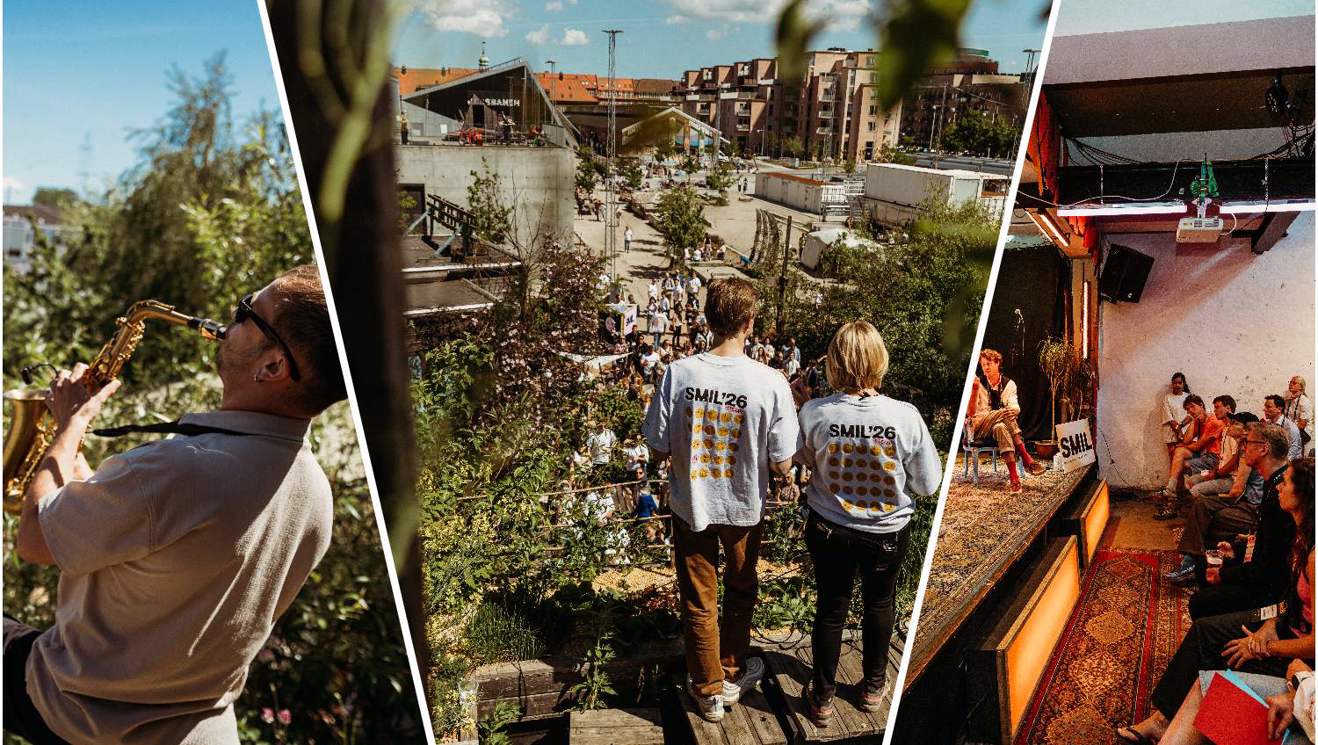
On a wooden terrace high above the Department of (X), which again this year forms the setting for SMIL, Mette Hoberg Tønnesen and Søren Lund Nielsen from Startup Aarhus welcome a gathering of founders, investors, operators and ecosystem people who have found their way to SMIL 2026.
The sun is shining. Plants crawl up the woodwork. Down in front of the stage, people stand close together as the sound of a funky saxophonist, chatter and anticipation mingle with the kind of buzz that occurs when an entire ecosystem is gathered in one place for a while. From a distance, it looks like a music festival. There are name tags, plastic glasses, small groups in the sun and a stream of people moving between presentations, workshops and informal conversations.


Launched last year as a departure from the classic conference format, the Startup Festival has gathered over 700 startups, investors and ecosystem players in Aarhus this year. Not for a day of keynotes and polished success stories, but for a festival of conversations, sessions and meetings across the board.
It all fits Aarhus very well. It is not Silicon Valley. It’s not London, Berlin or Stockholm. And that’s part of the point of the whole thing. Here, the ecosystem is small enough that you quickly run into the same people again. But big enough that international profiles, investors and founders from outside take notice of what’s happening.
SMIL’s own headline for the year was “Where startups move forward fast, together.”
It sounds like classic, bombastic startup rhetoric. Onward. Quickly. Together. But in fact, the day showed that “forward” doesn’t just mean more customers, more capital and steeper growth curves.
Errors as a common language
Up a narrow, makeshift staircase and winding nooks and crannies and all the way to the roof of a packed room in the A building, the session “Rethinking failure in the startup journey” put words to something that is often a big part of founders’ lives, but rarely given the same space as funding rounds, product launches and exits.
Namely, what doesn’t work.
The session was hosted by Roxy Dat from FailForward and aimed to create a more honest conversation about failure, adversity and the pressure to always appear successful to the outside world. As it was said on stage, FailForward is about building failure literacy in the Danish startup ecosystem. In other words, a common language for failure. Not just as individual failures, but as patterns, risks and lessons that the ecosystem can learn from.
The panel consisted of Emil Bruun Blauert, Karen Rafael and Anders Søndergaard. They started with personal stories that moved the focus away from the abstract business lingo and into the more messy reality of founder life.
Emil Bruun Blauert from Postevand (who was responsible for keeping the SMIL participants well hydrated during the day) talked about not being good at saying no. Not as a small character flaw, but as a pattern that he only began to understand the consequences of many years later. He took participants back to a night in 2006 when his wife was about to give birth to their second child, yet he answered the phone when his boss called late at night to talk projects.

He never really said no back then. It wasn’t until many years later that he began to work with what it had really meant.
Karen Rafael, who runs Bloom Advisory and advises founders and investors on people and teams, spoke about a divorce, a life crisis and a year where her own business didn’t grow the way she wanted. Not because she considered herself a failure, but because the numbers showed that something was difficult.
And Anders Søndergaard, who has sold companies (most recently the Aarhus company Coana) and can call himself both a serial entrepreneur and multi-exit founder, drew attention to the downside of these titles. Behind the stories of exits, traction and accelerator stays in Silicon Valley, there were also periods when companies were close to bankruptcy and when the public narrative of progress was miles away from the internal gut feeling.
“It’s not a beautiful journey,” he said. “It’s messy.”
In the startup world, two things can be true at the same time. A company can have momentum and be on the verge of falling apart. A founder can stand on a stage pitching investors with conviction and know that the current direction is unlikely to last. An exit can be a relief, a success, a compromise and a disappointment.
Vulnerability as discipline
But where is the line between being open and appearing to be a risk?
Anders Søndergaard talked about how vulnerability can be operationalized. If a founder can talk about uncertainty as assumptions, risks and validation, it doesn’t necessarily become weakness. It can also be professionalism.
Karen Rafael made the same point from the investor and team perspective. According to her, it can be a red flag in itself if a founder comes across as someone who knows everything and doesn’t need help.
“Investors actually appreciate it when founders are open about what they can do, where they are unsure and where they need help. That in itself is a red flag if you say, ‘We can do it all, no worries.’ No one is like that,” said Karen Rafael.
Emil Bruun Blauert added:
“We have to accept that two positions can exist at the same time. You can be vulnerable and strong at the same time. Maybe it’s actually connected today.”
He pointed out that you can be vulnerable and strong at the same time. Perhaps the two things are actually more closely related than many in the business world have previously realized. This stood in stark contrast to the old guard he described himself. The one where you run faster, work harder and don’t talk too much about how you really feel.
An international profile
At the same time, AJ Tennant stood in front of a packed audience in the hall downstairs in the A-house.
He has previously worked with go-to-market at Facebook, Slack and Glean and is currently founder and investor in Tenacity Capital. In other words, a profile that could have spent the day in many other places than at a startup festival in Aarhus.
In between the two blocks of presentations and workshops, TechSavvy caught up with the American profile for a quick chat. For AJ Tennant, the visit is part of a larger ambition to understand tech ecosystems outside the US bubble.
“I think you get a better world view and a better business perspective by experiencing the world outside the US – and especially outside Silicon Valley,” he said.
Last year he moved to London with his wife and three children. Since then, he has visited startup environments in Finland, the Netherlands, Austria and Germany. So it made sense to make his way to Aarhus.
“One of my goals was to really get a feel for different tech ecosystems. I’ve spoken at Slush in Finland and Denmark was one of the places I wanted to visit,” he said.
And Aarhus made an impression.
“It almost feels like a startup environment within a startup environment. Like a little microcosm of the startup ecosystems that are starting to emerge in Europe,” he said.
The atmosphere had also set in. From the rooftop opening to the founders and investors he met throughout the day.
“I love it. The weather is beautiful and the energy is palpable. The way it started up on the beautiful rooftop, where people started connecting and talking, worked really well,” he said.
For AJ Tennant, the day was not only an opportunity to feel the atmosphere in Aarhus. It was also a professional exercise in sharpening his own message to early stage founders.
“For me, it gives me a new experience in seeing how to create an ecosystem. And then I meet new startups and new founders. Strong talent can come from anywhere,” he said.
His professional point was that Go-to-market has become more important earlier in the startup journey.
“It’s easier than ever to build, vibe code and ship a product with the technology we have today with LLMs. Therefore, there’s now a bigger premium on how quickly you can distribute and how quickly you can go to market,” said Tennant.

That’s why he believes that seed founders need to think go-to-market much earlier than they did before.
“Now is the time to think about GTM earlier. Five or ten years ago, people didn’t think about GTM until much later. Now they need to do it earlier,” he said.
It’s especially about founder-led sales. In other words, founders themselves becoming better at selling, telling the story and qualifying the first opportunities in the market.
“What founders especially struggle with – especially seed founders – is improving and perfecting their founder-led sales. They need to think about telling their why and the story of why they started the company and what they are building. This will help them not only sell to customers, but also sell to investors and raise capital,” he said.
Then there are the more mundane sales disciplines that are often put off for too long: How do you qualify opportunities? How do you structure pilots and POCs? When does it make sense to hire the first salesperson?
“The US is generally faster to market. That’s something that needs to change in Europe. If all other things are equal and you build a product that can be sold into large markets, Europe needs to move faster on the GTM side,” he said.
Other animals in the forest
But what exactly is ambition?
This question was unfolded in the session “What if you don’t want to build a unicorn”, where the audience was thrown into a conversation about growth, ownership, impact and long-term value. Karoline Valentin Ry from Kitchen at Aarhus University steered the debate, which also involved the audience actively in the conversation with the so-called ‘fish bowl format’.
Here, perhaps the startup world’s most dominant narrative was challenged. Namely, that the most meaningful company is necessarily the one that grows the fastest, raises the most capital and becomes the biggest. And unlike the typical conference panel debate, there was actually fundamental disagreement on several points and genuine, sharply honed, perspective-broadening debate to be had. Delightfully refreshing.
Oscar Haumann from House of Small argued that bigger is not always better. According to him, if you really want to solve a problem, making the company as big as possible is not necessarily the best strategy. Instead, some companies should be designed to stay small and still make a big impact.
He pointed out that many progressive changes come from small businesses because large companies are often bound by the status quo, shareholder return and growth requirements.
Rikke Ullersted, co-founder of THE UPCYCL, nuanced the picture from the founder’s perspective. When the first investor joined the company, she was proud. It felt like recognition that the company could scale and that investors could see the potential. But with investor capital also comes a lot of obligations and requirements.

When you take in money, you’re effectively promising to deliver a growth journey. And you can’t just step out of that if you later realize that the market isn’t mature or that the growth requirements don’t fit the company or the founder’s way of working.
For her, it changed the role of CEO. Reporting, numbers and growth requirements became a heavy burden. It drained her.
Hadiyah Mujhid, founder and CEO of HBCUvc and scout at Ada Ventures, warned against making growth the enemy. There’s nothing wrong with growing or scaling, she said. The question is what you’re scaling and what type of company you’re dealing with.
Some technologies can have a huge positive impact if they reach scale. Other business models risk simply scaling more consumption.
Thy entrepreneur Alexander Bengtsen from VildIs brought the conversation down to a practical level. He talked about wanting to build a business that makes a difference, but also about wanting to live a life where he wants to get up in the morning. He wants to grow. He wants to take market share from companies he thinks are doing things wrong. But growth isn’t the only motivation. He also wants to surf. Sleep in once in a while.
It may sound almost trite. But in a startup context, where the founder’s life is often consumed by the pace of the business, it was actually a compelling point.
Maybe the question isn’t whether a company should grow. Maybe the question is what the right size is. When has a company grown up? Maybe there are other animals out there in the forest than the infamous unicorn.
Pole dancers and fire art
After a communal meal and even more networking, the day had to end in classic unpredictable and quirky Startup Aarhus fashion. Led by two armored personnel carriers with DJs in bulletproof vests, the participants were led to a container building, through a dark, narrow corridor, where a fruit-flavored drink was waiting. And then out into the light again, where you’re met by pole dancers and fire juggling. Yes, you probably should have been there.
Of course, there was still plenty of classic startup energy at SMIL. People pitched, chatted, exchanged LinkedIn profiles and talked about capital, customers and scaling. There was laughter in the sun, concentrated listening in shaded venues and chatting with new and old acquaintances.
But the heroic tale of the founder who always knows where the company is going, can always work a little more and should always chase maximum growth did not go unchallenged. Instead, boundaries, trust, pace, market access, investor logic, quality of life and mistakes were talked about as something we can learn from together.
Because if there was one consistent point across the day, it was that strong startups are not only built by strong products. They are also built by founders who can talk honestly about risks. By investors who dare to ask different questions than those about the growth curve. By ecosystems where relationships matter. And by companies that dare to define success in a way that fits the problem they are trying to solve.

